Monday, 1 December 2014

The Other Side of the Medal: How Germany saw the First World War

Tucked away in an alcove of the British Museum, off-shooting the Ancient Roman collection on the second floor is a small exhibition space dedicated to German commemoration of the First World War entitled: "The other side of the medal: how Germany saw the First World War." This was a small exhibition that was put on this summer to precursor the much larger exhibition "Germany: Memories of a Nation."

There have been a lot of exhibitions, specials, and lectures discussing the Great War and its impact. One of the most difficult aspects of studying the First World War is understanding the failures of diplomacy and how what should have been a small conflict between two states become a conflagration among the largest empires of the day. The war saw the end to three Empires (German, Ottoman, Russian), and left devastating consequences.

The psychological impact of the war cannot be overestimated. For many it was seen as a conflict of "Good" versus "Evil"; to the Allies a means of stopping an ever-expanding German empire and to protect a nation's right to neutrality. To the Central Powers, it was about honoring alliances and maintaing power. This perhaps is an over-generalization, but to many this was a war of ideals; the "War to end all Wars." Which if history has taught us anything such a concept is the equivalent of suggesting creating a fire to put out all fires.

Pax 1919
By: Erzsébet Esseö, Germany, 1919
Photo: By Amanda Chain
The British Museum

What makes this exhibition so poignant is the fact that what we normally associate with victory and success: medals, are in fact representing defeat. These medals commemorate disappointment. With the loss of the war the only survivor of the Central Powers was Germany, and thus had to take the brunt of the "punishment" for defeat. The terms of the Treaty of Versailles left the German people with a feeling of humiliation. The medal "Pax" suggests that there was much left to be desired on the part of the German people. Created by , illustrates the feeling of bitterness and devastation over the high cost of the war imposed on Germany. In contrast to the medals on display from the Allied countries, it is evident that the treaty was by no means accepted.

The Blockade
By: Karl Goetz, Germany 1919
Photo: By Amanda Chain
The British Museum

Another "The Blockade" takes this sentiment even further. It represents the allied naval blockade of Germany and shows starving figures behind a harbor wall that is wrapped in barbed wire. The blockade was in effect after the end of fighting in November 1918 and lasted until peace was formally signed at Versailles on 28 June 1919. Written at the top is "England's Schandtat" which translates to "England's shameful deed." It suggests the bitterness felt towards the allies who continued to blockade until the formal declaration of peace despite the armistice, not coincidentally this medal was produced less than a month after the Treaty of Versailles passed.

It is worth seeing the much larger exhibition now on display at the British Museum "Germany: Memories of a Nation, " which will include some of these medals, which opened on Remembrance Day and will run until the 25th of January.

Friday, 28 November 2014

Baryshnikov's "Dancing Away" Opens Tomorrow

Mikhail Baryshnikov
Photo: Courtesy of British Vogue

Mikhail Baryshnikov aka Carrie Bradshaw's Russian Lover, opens his first photographic exhibition in the UK tomorrow entitled "Dancing Away," which will run until January 31st at Continiart, 105 New Bond Street W1. In his exhibtion he explores two decades worth of material in the medium of photography.

Baryshnikov is a trained ballet dancer and so the subject matter comes as no surprise. It is his vision from both inside and outside the dance world that makes his work so interesting. His photographs emphasize motion of the moment. He writes in his press release:

"I take thousands of images, and it takes me a long, long time to select. My eye catches it and my heart stops. This is exactly what I want."

He's already garnered the attention and praise of publications like British Vogue and The Financial Times. For more information check out his press release Here.

Wednesday, 26 November 2014

10 Things I'm Thankful For

An Ex-Pat Thanksgiving
Photo Taken/ Food Eaten: By Amanda Chain

This is always the worst day of the year to spend out of the States. The FOMO disease can destroy you, but in the spirit of the day, I thought I’d share with you all 10 things I’m Thankful for in my home away from home:

1.    Boris Johnson:

This man is like Santa Clause. He bought everyone in London shiny new bicycles, and has been the feature on a number of documentaries. I recently found out he could legally become President of the United States and the last Brit in that scenario was Churchill. Any man that recites the Iliad whenever they’re feeling confused has my vote.

2.    Beyoncé

With 7-11 that just came out, Queen B proves that she can make people do just about anything. At first I thought what is this, and then when I was clapping my hands like a crocodile and twisting my left leg I couldn’t help but think B you know I care.

3.    Goodenough College

Despite what the contraction suggests, this place is Better than enough. I live with the most insanely awesome group of people that will be changing the world not some day, they’ve already

4.    My Faux Hunter Wellies

For the first couple weeks in London, I was worried these babies weren’t going to get much use, but they’re the most regular feature of my wardrobe. If it weren’t for those and the spare plastic bags I carry I’d live in constant sogginess from both the sky and the Thames.

5.    ULBC

They are the only reason I’ve had to adjust to no further than Zone 3. I’ve missed racing and being on a team, and joining UL I feel like I hit the jackpot. Although I have to remind myself I’m young and I’m not the only one on the planet that used to watch TRL, these guys are the best at Never Have I Ever and are so worth taking the Night Bus for on Saturdays.

6.    Cheese

I’ve been gorging myself recently in Borough Market and Neal’s Yard in Covent Garden, and if anyone has a death wish, get between me and my cheese. Thank you England for your mad cows and goats! I’m essentially training to win a cheese-rolling contest so I can get my own wheel.

7.    Lindsay Lohan

Just when I thought I’d have little entertainment, Lindsay goes and moves to London with me to do her show on the West End Speed the Plow. Although it’s no Parent Trap, you’ve given me an excuse to use a Mean Girls reference everyday and scowl at anyone who doesn’t know what I’m talking about.

8.    Tom Pugh’s Tea Parties

Every Sunday afternoon without fail Tom Pugh makes the best scones clotted cream and provides anyone and everyone in the College with as much tea and scones as they could possibly handle. The Brown’s Hotel and the Park Hyatt could learn a thing or two from you.

9.    Daily Mail

I don’t read the Daily Mail for news. I read the Daily Mail for reasons why kids watch cartoons. They like pictures with words that have not so subliminal messages. Thanks DM for my tube ride entertainment!

10.  Citymapper


If it weren’t for citymapper, I would not get anywhere ever. Although sometimes you have failed me interms of approximating distance, it’s safe to say I’m game to try the catapult option if it will get me anywhere I want in a minute, although rain safe will do just fine for now.

Tuesday, 25 November 2014

Amsterdam Art Weekend

Get your Eurostar ticket or book your flight to Amsterdam. This coming weekend is the Amsterdam Art Weekend. All participating galleries are creating exhibitions just for the show, and you're unlikely to find anything like it again. Most of the artists are residents or alum of the Rijksakademie or De Ateliers (two of the most prestigious artist in residence programs in the city). These artists have international reputations and their work tends to be incredibly specialized.

There will be a number of exhibitions, performances, and gallery specials. This event will give viewers the opportunity to meet the artists so that no matter what you walk away feeling you've got your finger on the pulse of Contemporary Art and Design. There are a number of interactive and film projects, although if you're like me and prefer photography and painting then the artists to see are Marlene Dumas and Vivian Maier.

"Amy - Blue" (2011)
© Marlene Dumas
photo: Peter Cox 
Image provided by: The Stedelijk Museum

Dumas' exhibtion "The Image as a Burden" is currently running at the Stedelijk Museum and will be running until January 4th. So if you miss the weekend, you'll still have a chance to see her work. Her highlighted piece is the "Nuclear Family" (2013) but I'm quite partial to this one entitled "Amy-Blue" (2011). I was and still am a massive Amy Winehouse fan, and her death was both tragic and premature. This painting captures Amy's struggle with success, drug dependency, and a volatile relationship. I love the way Marlene focuses on the emotional condition of the figure and tries to bring that through to the viewer.

"Vivian Maier"
New York, 10 September 1955
© Vivian Maier
Maloof Collection
Courtesy Howard Greenberg Gallery New York, 1955
Foam Fotografiemuseum, Amsterdam

Vivian Maier's exhibition "Vivian Maier- Street photographer" at the Foam offers that metropolis decadence experience I crave. Maier passed in 2009 and her work spans her life through living in New York and Chicago. The professional nanny, documented her life through photography and left about 150,000 negatives by the time of her death. It is interesting that none of her work was discovered until the end of her life, she certainly would have been considered just as talented as her contemporaries. She also made a number of recordings and motion pictures in addition to photographs. This exhibition focuses on her work from 1950-1980 and includes a number of pieces. I love her self-portrait. I've had to bite my tongue and not say "Selfie". She encompasses the view that a self portrait should display how you view yourself, not how you wish to be seen. The focus is on identity not display. As I think art should be.

Monday, 24 November 2014

Shakespeare's Rose Theatre

“I know a bank where the wild thyme blows,
Where oxlips and the nodding violet grows,
Quite over-canopied with luscious woodbine,
With sweet musk-roses and with eglantine.” 
― William Shakespeare, A Midsummer Night's Dream

The Rose Theatre Foundations
Southwark, London
Photo: Courtesy of the Rose Playhouse

The history of the Rose Theatre is something that could easily be mistaken for a plot in one of Shakespeare's plays. It follows a tale of love, loss, and renewal. It changed archaeological excavation in Britain and ushered in a notion of in-situ preservation that was at the time not part of the British Heritage canon. It is the efforts by people campaiging to "Save the Rose" that helped change the scope of preservation for what constitutes English Heritage today.

The would be destruction garnered intervention from a number of famous actors like Lord Olivier, Dame Judy Dench, and Sir Ian McKellen as well as the general public and for good reason. Although all that survives is the foundation, the site in conjunction with the Dulwich papers offer greater detail about the Elizabethan stage than any contemporary playhouse. And what's more is the distinct difference that although covered in protective sand, we've learned more about how sustainable means to preserve organic materials from this site more than any other as this has been in practice for over 25 years.


In a routine exploratory excavation, the Rose was rediscovered in-situ in 1989. The site was scheduled for clearance and re-development into an office block. For those of you that have been to see a play at the Globe, you might be disheartened to learn that is not where the globe actually stood. The interpretation, although certainly impeccably close to what the Globe probably looked like in the 1650s before a fire destroyed it, it is missing something in its ambiance that the Rose has. It is a classic case of aesthetic versus authentic. 


Does the Rose feel more authentic? This is where Shakespeare and Marlowe actually performed their plays, carefully marked in red lighting. Regardless of the fact you are surrounded by cement, and there is a pool of water around it as the Thames is tidal, and rises twice a day. Maybe this is more real than the Globe or other similar playhouses? Both offer different versions of authentic. And you'll have to judge for yourself which you prefer, but the differentiation between the two is an interesting discussion to have.


Click Here for details about What's On at The Rose Playhouse.

Saturday, 22 November 2014

Borough Market: The Melting Pot


Borough Market has been an active market for over 1000 years. It became a staple in the 12th century when it saw the building of the Bishop of Winchester's Palace only a few meters away. Borough Market was the source of fresh fruit and vegetables for the people of London living and working on the other side of the Thames. It wasn't until the twentieth century when the market lost its identity to the growth of supermarkets and convenience stores.


Normally, I'm quite sceptical of gentrification of neighborhoods; they have a tendency to lose their character, but in this case the Borough market needed to and found a new identity. Riding the wave of interest in organic foods the market expanded this niche market and gained popularity in the 90s. Now it is a vibrant spectacle of produce and ready made meals. You can find specialty items as well as daily produce at reasonable prices. The mushroom stall above sold variety packs for only a few pounds.


I have a general rule of avoiding intensely public places around London on Saturday afternoon and Borough Market is no exception. And worst of all, went at lunch time. Not my smartest move, but I was in the area anyway. I did it today and found myself moving at a snail's pace. However, I found I was "forced" to stop and try the food at every stall. Sorry I'm not sorry. Instead of a set lunch I highly suggest this method of consumption. I left quite satisfied without having to spend anything.


However, I would be lying if I said I didn't buy anything. I went to the place above called The Urban Cheese Maker. The people here are super friendly and the cheeses were above par. The are located around Tottenham Court, and recently won the Bronze medal for their "Alexandra." The cheeses are of a mild variety, which for me is ideal, but if you're after the Münsters then this might not be your stall. They also have a great Stilton without the blue vein. Blue cheese without the blue is easier on the palate.

If you haven't smelled a truffle then get yourself to Tartufaia quick and try it. It took all of me to remove myself from this stall. Certainly the samples here were the highlight of my visit. You can get Truffle oils, pates, and all sorts of wild mushroom products. I was specifically shopping for a dinner party and could not bring myself to just buy truffles for the sake of it, but it was tempting.


One aspect among many that I admire about Borough Market is that it has become a melting pot of diverse products and foods. You can get just about any delicacy from around the world, and all of it fresh and quite a few are from sustainable organic farms. You get the feeling that you aren't supporting Big Business, but rather the people of London. It is one of the best markets in the city for experiencing the cosmopolitan nature of London that it prides itself on.  Although it is by no means the best structural representation of Victorian buildings, and has expanded from its original purposes in the Middle Ages, this Market has become a top attraction in London and for good reason.

Friday, 21 November 2014

The Sherlock Holmes "Museum"

221 Baker Street: The Sherlock Holmes Museum
Photo: By Amanda Chain

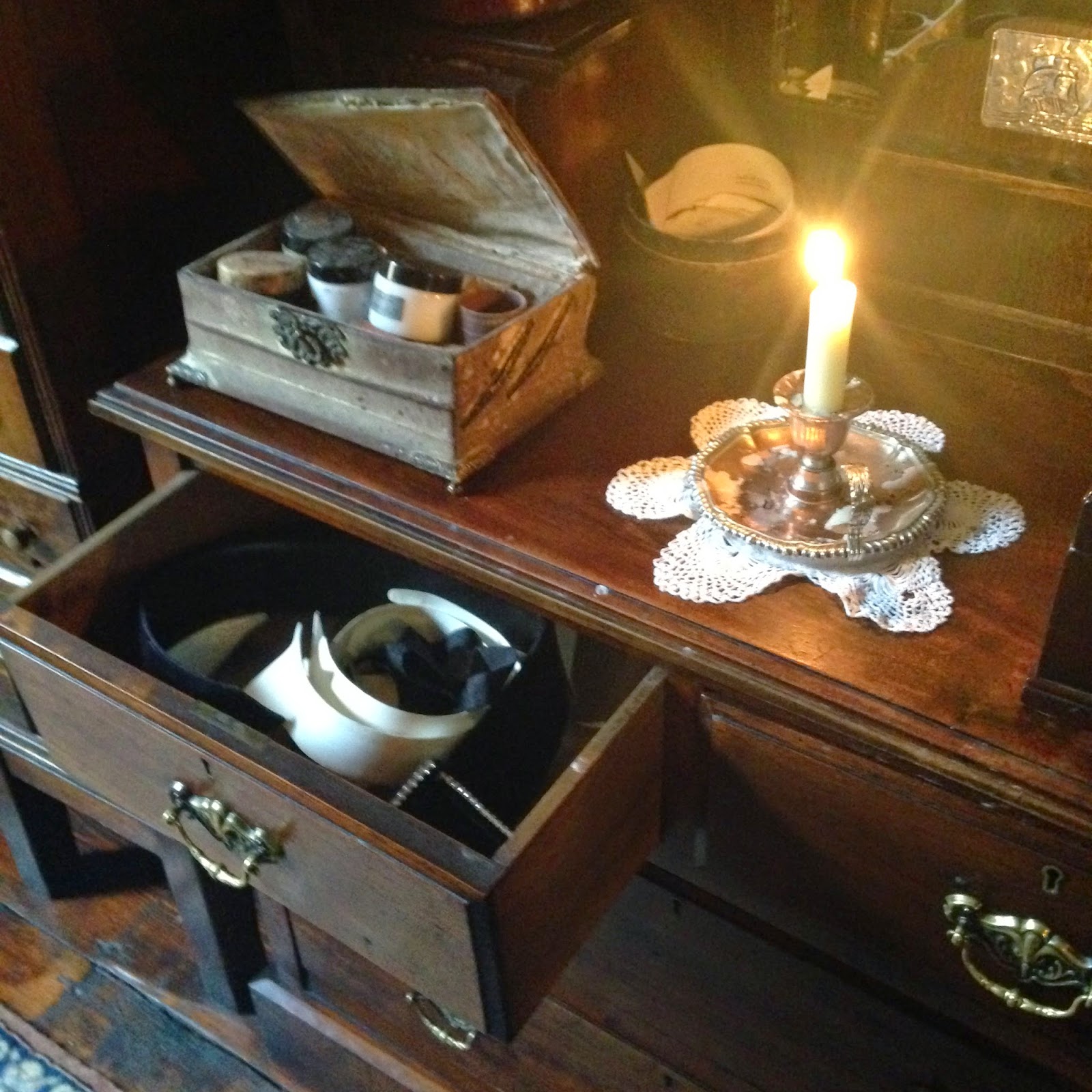
This museum may have just won my heart. The Museum is a recent institution officially opening in March of 1990, bares all the appeal of a museum, but at the same time does not follow the sort of "authentic" nature you might expect in one. Beginning with its address, 221b sits between 237 and 245 Baker Street, and the museum petitioned to have the "official" address from the city of Westminster. Also, above it you'll see the familiar blue plaque from English Heritage that commemorates residences of famous Londoners; however, this is not  a real plaque, as they don't officially recognize residences of fictional characters.

Sherlock and Dr. Watson's Sitting Room
Photo: By Amanda Chain

But in all it's fakeness, this museum was one of the most interesting and authentic museums I've been to in London. For starters, the rooms were made to the scale and style as depicted in the novels. The paraphernalia that adorn the house are all era appropriate. You're encouraged to touch the objects and sit in the chairs and immerse yourself into the world of Arthur Conan Doyle's imagination. It represents a lodging house of that period and is a Grade Listed II building in its own right for its architectural and historical interest.

Sherlock's Bedroom
Photo: By Amanda Chain

It doesn't really matter that the address isn't real, and its most famous inhabitant never actually existed. What's important is that you come away with a tangible feeling of entering this alternate reality where he can and does exist. In someways, it is the connection to the tangible that makes this work so well, and there is no issue of conservation because what you touch can be replaced. The idea is conserved.

Letter Written to Sherlock Holmes
Photo: By Amanda Chain

A number of figures are positioned to create the illusion of various events in the Sherlock Holmes stories. Even Moriarty makes an appearance, as does a Hound of Baskervilles. My favorite attraction to the museum by far is the treat that is reserved for the end. There has been quite the legal dispute over who owns letters written to Sherlock Holmes, and since the dissolution of the opposing party, the museum retains all letters now addressed to Sherlock Holmes 221B Baker Street. It makes you wonder does it even matter that he's fiction? It begs the question: to be a museum, does everything have to be "real"?

Popular Posts