Monday, 25 January 2016

London's Modern and Contemporary Art Scene: The London Art Fair 2016

The London Art Fair 2016
24 January 2016
Photo By: Amanda Chain


This week (20-24 January) hailed the onslaught of the best in British Modern and Contemporary Art. In it's twenty-eight installment, the London Art Fair gave collectors and general enthusiasts alike a peak into the up-and-coming and the soon to be stars of the London Art Scene. Set in the Business Design Center in trendy Islington, the London Art Fair has the accessibility to the contemporary with less pretension and overstatement of the Frieze Fair.


Here, London's top galleries swarmed to show off the best in show, while also getting a chance to highlight permanent collections, such as the incredible curation of the Jerwood Gallery's permanent collection curated by Director Elizabeth Gilmore and Lead Curator Lara Wardle entitled "Coast" displaying artists whose work was centrally influenced by the geographic elements of one of the world's oldest coastlines including the likes of Christopher Wood and John Piper who also feature heavily throughout the fair. There were plenty of big names to choose from including personal favorites: Barbara Hepworth and L.S. Lowry, and also shining stars like sculptors Shaun Doyle, Mally Mallinson, and Anna Gillespie. Some of the most sought after pieces came from mixed media artists like the Connor Brothers and more traditional painting styles and and some spectacular photography. Although this is by no means the definitive list, here are my top 5 personal highlights.


Truth Is Weirder Than Any Fiction I've Seen, 2015
The Connor Brothers
Mixed media on canvas
191 x131 cm
Unique £7,500 Plus VAT
Photo By: Amanda Chain
Pertwee, Anderson, & Gold, 15 Bateman Street, London W1D 3AQ

The Connor Brothers exhibition at the Pertwee, Anderson, & Gold was amid with buzz. Located just to the right on the ground floor by the entrance this was one of the premier locations at the London Art Fair. By the time I arrived there were numerous editions of their work already sold. Much of it like this piece Truth is Weirder Than Any Fiction I've Seen, 2015 is thought-provoking. Images of models and book covers are juxtaposed with quotations that make the viewer do a double-take. Classic imagery meets literary persuasion, which seems in this case to become the Fine Art response to memes that take over today's social media.


Mama Bear, 2015
Nicola Hicks
Plaster, Straw and Tar
46 x 50 x 50 / 81 1/8 x 33 1/8 x 20 1/2 in
Flowers Gallery21 Cork Street London W1S 3LZ
Photo By: Amanda Chain

Nicola Hicks recently held an exhibition towards the end of last year which displayed her clever sculptures made out of tar and straw. The exhibition entitled Pause was a massive success and she showcased her talent for depicting real as well as mythical creatures. Her material choice makes evident the rawness of the subject. The seemingly harsh edges are used to display a broader banality of the subject. Working from memory Hicks attempts to create something both of this world and of her own imagined interpretation to create a new way of looking at things we think we've already seen.


Sumo Ergo Sum (I Shop, therefore I am)
Shaun Doyle & Mally Mallinson
Cast Bronze
Edition of 9. Sign and numbered. 2015
H 42.5 x W 45 x D 55 cm
£4,800
Paul Stolper 31 Museum Street, London WC1A 1 LH
Photo By: Amanda Chain

This piece by Doyla and Mallinson had visitors questioning the consumerist culture of the twenty-first century. Taking the classic latin quote by Descartes "Cogito, ergo sum," I think therefore I am and applying a critique on modern culture. The cast bronze is the sort of piece that emphasizes the accessibility of art at the fair. It is a simple statement supported by imagery that has a deep-seated effect by resonating immediately to the onlooker. The weight of material goods on the bare bones does more than just raise the question of whether "shopping' has taken over the societal conscience but furthermore that it is destroying it.


Mappa Mundi Major Londinium, 2015
Ewan David Eason
Black UV treated ink on 24 Carat Gold leaf mounted on Aluminum panel
Signed and editioned by the artist
195 cm Diameter
Edition of 3
£12,000
TAG Fine ArtsUnit 129a BDC, 52 Upper
Street, London N1 0QH
Photo By: Amanda Chain

There was quite the buzz around TAG Fine Arts showcase. There were a number works with more than a mere hint of political charge. The theme at this event was centered around geo-politics and included various maps with laser-printed passport reconstructions to signify place and identity. Among these works was a piece by Ewan David Eason entitled: Mappa Mundi Major Londinium, 2015. This work was stunning not only for its sheer size, but for the intricacy of the detail within the piece. Eason is a product of the UK having received his BA Hons in Fine Art from Bath Spa University College in 2003. He has since gone one to build a repertoire of work that illustrates the ancient and medieval through mapping. He particularly uses the Charles Booth's Poverty Maps as a point for inspiration. In this work he uses gold to draw attention to the egalitarian nature of people without the all-encompassing product of location by using a precious material like gold to bring the viewer in to the work.


Rain
Anna Gillespie
Bronze Edition 1/5
£14,000
Beaux Arts Bath48 Maddox St, London W1S 1AY
Photo By: Amanda Chain

Anna Gillespie is what we call "mover and shaker" in the British Contemporary figurative sculpture scene. Much of her work centers on the environment in which the sculptures are made of natural materials that compliment their surroundings. Some of this year's pieces were just so made out of material like acorns. This particular work is bronze and demonstrates the erosion process of the material after rainfall, although not clearly a depiction of rain itself. Some of her work is exhibited in parks and other places such as Gloucester Cathedral, and by Saturday afternoon it was clear that her work was selling quickly.


The London Art Fair is by no means unpopular, this year saw unprecedented numbers and backing by major sponsors like Sotheby's Institute of Art who was a major partner as well as Infiniti and The Art Newspaper. What makes this event more accessible is that the work is aimed at the Middle Market. You won't find works worth millions here, but you will find works ranging from
£100 to £100,000, and a whole lot in-between. Here is art for the general consumer, some of these works were political. There seemed to be a particular occurrence of immigrant and refugee subject pieces giving the feel that this was art "of the times." It was in a word: relatable. The talks during the day were aimed at trying to determine the position of the art market for the general consumer highlighting issues that are hot topics like: public versus private collections and encouraging diversity in art and photography.

Even if you found yourself on the other end, and missed the event, make sure to visit the website at London Art Fair so that you can get a full list of the galleries present and talk re-caps. 


The London Art Fair, London, 20-24 January 2016

Tuesday, 29 September 2015

Bournemouth and Poole: Dorset Coastal Break

Sun Setting in Poole
Poole, United Kingdom
Image By: Amanda Chain

Summer's pretty much over, and I have found myself scrambling in the midst of rainy London trying to get a dose of Vitamin D anywhere and everywhere I can. Some of the most overlooked and undervalued places, have been hiding right underneath my nose. Britain doesn't garner the same emotion as the more popular seaside retreats of its Mediterranean EU partners, but the South coast does have something to offer.

Dorset in particular is known to be one of the most popular destinations for professionals outside of London. Poole alone has some of the best surgeons and veterinarians in the country making it a popular destination for families trying to escape the throngs of London life, for a slightly more relaxed and slower paced lifestyle.

Watching the Fireworks in Bournemouth
Poole, United Kingdom
Image By: Amanda Chain

I spent this weekend with a lovely family that were able to show just how much this seaside retreat has to offer. Starting with a fireworks show, we had a proper welcome on the Sandbanks Beach. Every Friday evening Bournemouth puts on a fireworks show that can be seen well outside the city. Right on the coast, it's best to walk down to the beach for 10pm and watch the 20 minute show.

Saturday we had a lovely boat ride through Poole Harbour, it was clear how the Jurassic Coast of Dorset became a UNESCO World Heritage Site in 2001. The 95 miles of coastline demonstrate 185 million years of earth's history. On the Poole Harbour end you can see the famous Old Harry Rocks, and on the opposite Durdle Door.

The Walk along the Studland Beach
Poole, United Kingdom
Image By: Amanda Chain

After a breeze around the Harbour we went up the solent and through the river to Warehem. A small town on the river Frome it was a perfect place to stop and have a pub lunch at The Old Granary. In operation for over 230 years, this pub is one of the last standing family brewers in the region. I enjoyed the Badger Beer-Batter Fish and Chips, one of their signature dishes. As dark clouds were forming we opted to sit inside to avoid any potential rain. After a sufficient stop we proceeded back though the river to try our hand at wake-boarding. And by we I meant they, as I watched and lived vicariously through them. With wine spritzers, I was happily content in my seat on a speeding boat watching as the kids did all sorts of tricks and jumps off of the boat.

Bankes Arms
Poole, United Kingdom
Image By: Amanda Chain

Sunday was a late start, but we still managed to spend a few hours walking on one of England's nicest beaches. After taking the Chain Ferry over to Studland Beach we were able to enjoy the sun, sand, and surf. Studland is also a nature reserve and the beaches are overseen by the national trust and is known for some of the best coastal path walks and views of Old Harry Rocks. You can rent kayaks and canoes and discover bird life. Along the South and Middle beach are a number of huts that you can rent for the day or the week and cook and relax for the day. There are two amazing options for a pub lunch. One is the Bankes Arms and the other is the Pig on the Beach. Both have fantastic views of the coast and are worth relaxing at after a nice walk down the beach.

Boats at North Haven Yacht Club
Poole, United Kingdom
Image By: Amanda Chain

We then said goodbye to Dorset and returned home on the national express bus to London Victoria. Sorry to say goodbye, and well relaxed after a weekend by the sea.


Thursday, 13 August 2015

Proms at the Albert Hall

Proms 36: Wednesday, August 12th 2015
BBC Symphony Orchestra
BBC Proms, Royal Albert Hall, London

Having never gone to my Senior Prom, the idea of a summer full of Proms at first seemed a little overwhelming. But Proms in London is completely different than the American idea of Prom. Here they're classical music concerts put on by the BBC that premier live on BBC Radio. They a unique music festival that date back to the first held on the 10th of August 1895. This year thus marks 120 years of Proms. The intention was to bring the best possible music to the widest possible audience. Tickets start for as low as £7.

One of my regrets about living in London is that I have not been able to really experience the music and theatre life that is so rich and diverse in the city. However, last night Lady Luck was on my side and I was able to see Prom 36 which featured the work of Boulez, Ravel, and Stravinsky played by the pianist Marc-André Hamelin.

The focus of the night was on Paris and the post-First World War world. It was the first premiere for Boulez's 1958 piece Figures - Doubles - Prisms. Which, to be honest, was far more technical than I was able to appreciate. He combines a sophisticated technical ear for sound to create fantastical virtuoso. However refined, it gave me the impression that the orchestra was competing within itself, striving for attention that I'm sure for someone with more of an ear music.

I was far more blown away by the two Ravel pieces. The first Frontispice (1918, orch. 2007) had its debut at the Proms. Intended for two pianists it lasted only a short two minutes. It was written at the request of the Italian poet Ricciotto Canudo which went to his poem La poème du Vardar which was inspired by his First World War experience. Arranged for the orchestra by Boulez, the piece mixes both color and urgency with the use of the solo violin and the piccolo.

The second Ravel piece was so moving, it was only after that I realized just how meaningful it was. The Piano Concerto for the Left Hand (1929-1930) was written for the left hand of Paul Wittgenstein. It's his most successful Concerto by far. Wittgenstein lost his right arm in the First World War, and attempted to reassemble his career as a pianist by further developing his left hand skills. He commissioned a number of scores from composers of the day. When he was given Ravel's piece he thought it was terrible, but after several months he learned to appreciate it, however he made adjustments to the score, which deeply enraged Ravel. He attempted to stop Wittgenstein from playing his version, but eventually acquiesced.

The Piano Concerto for the Left Hand (1929-1930)
Featured Pianist: Marc-André Hamelin
BBC Symphony Orchestra
BBC Proms, Royal Albert Hall, London

The work is an emotional rollercoaster for lack of a better analogy. The tempo works at various movements allowing the pianist a reprieve. The pianist is ushered in once more after a sustained crescendo and returns with an almost lyrical melody. The combination of wind with the piano and string and bassoon for the reprise of the Lento give the piece a relentless press to the ultimate finale.

The last piece was the popular Stravinsky piece The Firebird which comprised of the two first scenes from the ballet. The movement comprises the arrival of the the Firebird, the bird's spell and the awakening and death of Kashchey. I always enjoyed the fairytale of the Firebird, and the dance of the firebird from the ballet. There is something both aggressive and vulnerable that when hearing only the music takes on a deeper resonance of the dynamism of the characters.

I do feel as though the evening achieved its purpose. Playing to a packed house the Royal Albert Hall is an incredible venue to be introduced to some of the most talented composers of Nineteenth and Twentieth centuries. Armed with all the captivation and romance that one could expect with an evening's selection formed around the theme of the city of Paris, it was impossible not to be swept up in the cascading movement of the music. There are still quite a few Proms selections left this month that are worth highlighting. There will of course be more opportunities to experience Boulez and perhaps submerse yourself into the technical genius' repertoire as well as some other favorites such as Mozart and Bach who will be featured next week.

CLICK HERE for more details about the Proms and for the complete schedule CLICK HERE

Monday, 13 July 2015

Decisions: You want it all but can you have it All? A look at Carsten Höller at the Hayward Gallery

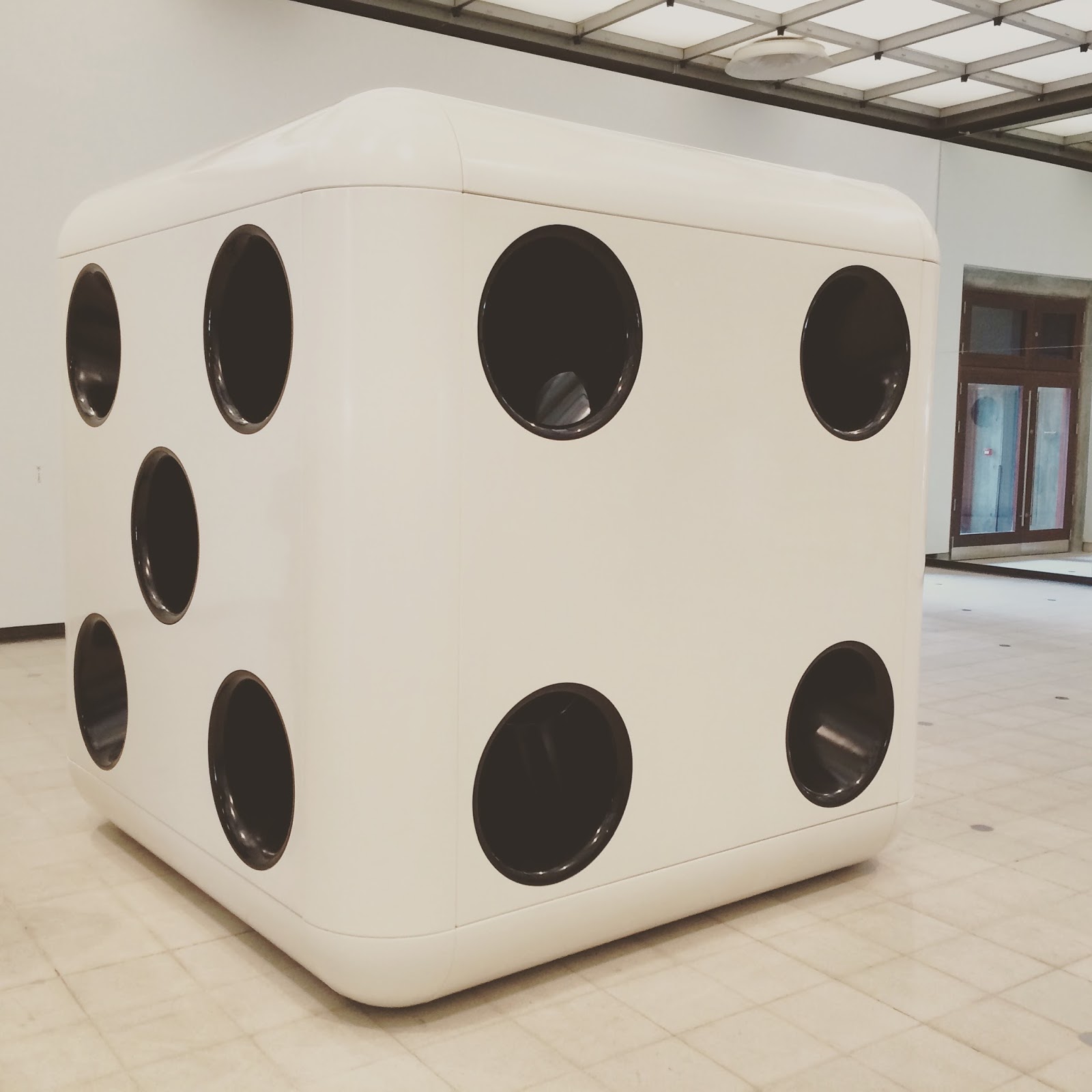
"Dice (White Body, Black Dots), 2014
Carsten Höller: Decision
10 June - 6 September 2015
Hayward Gallery, Southbank Centre, London
Photograph by: Amanda Chain

The Southbank Centre puts on a number of shows, concerts, and exhibitions. One that has been gaining in popularity, especially among the young adults is Carsten Höller's Decision exhibition on now at the Hayward Gallery.

For twenty years, Höller has been attempting to get his audience to rethink the way they see art and exhibitions through the creation of a myriad of devices, and situational installations that interweave people between various psychological states. He intentionally forces his audience to venture out of their comfort zone, and this exhibition is no exception. Upon entering, you are given the choice of picking two entrances. They alternate signs between A and B, although both provide the same experience. You are taken through a maze of disintegrating light and forced to find your way through darkness in an enclosed space.

This is the first of many instances throughout the exhibition that asks visitors to make a choice. His intention is to bring out so-called "moments of not-knowing." However, it is impossible to take a part the void of knowing and the indecision out of the setting. Knowingly visitors enter the museum expecting to touch, see, and do, and yet at many occasions are they reminded of "museum etiquette." Reminiscent moreso of behavioral psychology than the decision-making process, visitors are still influenced in their actions by gallery assistants telling them protocol.

In this regard, I find the exhibition somewhat lacking. In addition there are a number of installations that appear to have no purpose at all. I found myself more enthralled by a large die in the middle of the room through which I wasn't suppose to crawl (Dice: White Body, Black Dots, 2014), but could indeed poke my head through rather than the fat pink snakes in the middle of the room with a not-so-imaginary boundary around it (Half Mirror Room, 2008/2015). Although you are very much part of the exhibition and your actions are what determine your experience, I can't help but see how mediated this experience actually is. My group and I felt the need to recall the article by Tony Bennett entitled "The Exhibitionary Complex" in which he discusses how the structure of a museum influences our behavior an how we interpret everything inside.

My greatest disappointment surrounded the two roaming beds. It's all well enough to look at beds that appear to be moving themselves around an empty room. What would be far more entertaining would be the option of laying on one of these beds and feeling as though you are being taken in an unknown direction. The experience of which I'm told you can purchase an evening of for a mere £400. However, there are a couple I didn't even bother, such as the Memory Game and Table, which looked like a disheveled child's play area (Memory Game and Table, 2013).

One of the most memorable however, would have to be the goggles (Upside Down Goggles, 1994/2009). You are given a set of goggles and escorted outside to the terrace to which everything you see is reversed. The sky is down, the ground is up, and you are completely disoriented. Should you choose, you could spend a few hours getting your eyes to settle and adjust to that norm, however my general fear of falling off buildings, made me spend not nearly as much time on this installation.

Yet my favorite would have to be the last installation, if even it was that: the slide. The kid in me made me love that aspect of fascination of spiraling in an unknown direction into a space you only know to be down from whence you came. Höller described these (Isometric Slides) as a "sculpture you can travel inside and a device for experiencing a unique condition somewhere between delight and madness." I find madness to be somewhat more intense a term, but nonetheless fairly accurate.

Regardless, I did enjoy the exhibition as a whole. It made me seriously contemplate what it was I was experiencing and what I was meant to gain from this awareness. And furthermore, I had to accept the decision of each opportunity for action no matter what. Alea iacta est.

Tuesday, 7 July 2015

Henley Royal Regatta 2015

"Leander Club and Boating Dock from Henley Bridge"
Henley-On-Thames, UK
Photograph by: Amanda Chain

Henley never ceases to amaze me. Whether it is the fact that the majority of people that attend are more concerned with picnicking, Pimms, and being seen, or the fact that it passes by unnoticed most of the time as it falls at the same time as another major sporting event: Wimbledon; Henley is the unsung subtle hero of British sporting institutions.

"Henley Royal Regatta: Spectators" 2012
Henley-on-Thames, UK
Photograph by: Amanda Chain

As a rower, I find it absolutely incredible how what normally would be considered one race, in actuality becomes a Five-Day event, ranging with participants as young as 15 to ages exhibiting much more maturity. It brings junior and national team representatives into the same realm and inspires young athletes and mesmerizes the older ones.

This Henley was rather meaningful on two respects. The first was that for the Women's Henley which took place two weeks prior, after a grueling year I was able to win the Intermediate Academic 4+ with the University of London Boat Club. I had come over when I was a junior and lost with Mount Saint Joseph Academy and so this was especially poignant as MSJA brought over girls to race again and my old coaches were able to witness the race. It felt like something out of a Disney movie to be honest.

"Intermediate Academic 4+ Winners ULBC 
with The Cathy Cruickshank Trophy"
Henley-on-Thames, UK
Photograph Courtesy of: Beth Welch

The other poignancy comes from the fact that I spent the last three years of my life coaching at Winchester College and this year, I watched the boys from Winchester College compete, the majority of whom I taught to row when they first joined the school. They had an admirable showing but lost to a crew traveling from the States by a little over a length open water. The boys are majority J16 so they have many more races ahead of them, it was so nice to see them compete with "the big boys," and still stack up phenomenally.


"Winchester College racing Boston College High School"
Princess Elizabeth Challenge Cup
Henley-on-Thames, UK
Photograph Courtesy of: The Henley Royal Regatta
www.hrr.org

In fact, there were many crews traveling from the States including University of Washington, and the Ivy contingent of Harvard, Yale, Columbia, Brown, Cornell, and Princeton, with a few representatives in the University Barge Club from my alma mater UPenn. I'm not even going to get into all the various countries represented, of which there were many.

This year was the first expansive effort for live coverage of the racing. Drone cameras made it possible for viewers to watch from all over the race course and video screens set up in the Steward's enclosure made it possible to see the racing from start to finish. For people who are not well-versed in rowing it made it a lot easier for them to understand what was happening with each race in conjunction with the announcers and of course the leader board. To see aerial footage of rowing was breath-taking and unlike anything I had ever seen with the sport. It changed the vantage point, and made me see rowing in a different, more exciting light.

"Live Drone Footage from Racing on Friday Morning"
Henley-on-Thames, UK
Photograph Courtesy of: The Henley Royal Regatta
www.hrr.org

This year being the year before an Olympic year tends to bring a number of athletes from abroad. As England is the birthplace of rowing, it should come as no surprise that the most prestigious event takes place here. Aside from the Olympics, there is no other regatta that commands the same respect and reverence from international rowers. Hence the presence of sporting celebrities like New Zealand's Mahe Drysdale who is an Olympic gold medalist in his own right, and the Czech Republic's Miroslava Knapková who also won gold in the London 2012 Games.

The number of people drawn to the banks of the Thames is an ever increasing figure. Although the event retains is prestige, it is slowly becoming more accessible for competitors from all over the world to take part. It is not so much a British institution as it is an International one these days, and this is seen by the ever increasing numbers of world-class athletes coming over for the opportunity to participate, and the chance to win the renown Little Red Box.

Wednesday, 24 June 2015

A Tower with a View: Rundetaarn

View from the Rundetaarn, Copenhagen
Photograph by: Amanda Chain

Every time I make a trip to the Nordic/ Scandinavian countries I am never disappointed. On my recent stay in Copenhagen, I unsurprisingly found myself looking for jobs that would allow me to stay in the gorgeous town indefinitely. It's impossible not to fall in love with this city.

One of my favorite stops was the Rundetaarn. Luckily we stayed across the road, and it was fairly impossible to miss, but this unsuspecting tower in the heart of the city is one of the best-known structures in Denmark. Since 1642 people have been visiting to enjoy the incredible view from above. A number of lofts along the way up make the tower a great spot to visit and learn about the history of Copenhagen. Their is a Library Hall which once served as the university library, and now hosts a number of exhibitions. When I visited it was an exhibition of tattoos.

The building unsurprisingly seems to be an extension of this part of the city. It was designed y King Christian IV himself, and the interior spiral ramp is equally as timeless. The tower is open to all 362 days a year which makes it a staple for those visiting the city. Even if you don't plan on staying long, it's worth it for the view alone.

Wednesday, 17 June 2015

What Do We Remember?: Commemorating the First World War Centenary and British Identity


"ANZAC Day War Memorial"
London, United Kingdom
Photograph Courtesy of: BBC

War, and particularly the First World War, has made a cultural, economic, and physical impact on the landscape of Britain. After the final soldier passed, Britons choose to continue to honor the legacy of those who fought through memorializing. This choice to remember, to observe the centenary, 2 minutes silence, to wear poppies, and to attend services, speaks to the British national identity.

When we imagine the First World War, we do so in a context of mythology and metaphor. No longer do we conjure specific dates and battles as easily as we do mud, gore, and death, or I should say most importantly death. The Great War has become so because of the cultural impact it created on its time, and the legacy of that impact on the generations that followed. Upon the centenary we are compelled by some ardent desire to come to grips with what this legacy has become and what it means in Britain today.


"The Futility of War"
Imperial War Museum Archives, London
Photograph Courtesy of: IWM

Although there are a number of mythologies and metaphors that can be used to look at how and why we choose to remember the War, however grim it may be will be through the mythologizing of death. Death is the primary way in which the war is mythologized and remembered. Through the topic of death we are able to ask questions about purpose, tragedy, legacy. When we imagine the First World War, we evoke images of trench warfare, mud, but also the horrendous scale of casualties that resulted. The numbers are physically hard to take in and so through poetry, novels, memoirs, documentaries and film we are able to in some ways comprehend the scale of violence.


"Mud"
Imperial War Museum Archives, London
Photograph Courtesy of: IWM

It is less easy to remember the monotony of trench life, shuffling supply lines, digging, waiting and sleeping that took place. We focus on the Western Front Battles despite the ones fought throughout Africa, Asia and the Middle East. Even the Western Front was not constant fighting. Long periods of stalemate meant soldiers more commonly waited for orders than living in constant bombardment and attack. 

That is not to say there wasn’t tragedy. Although the numbers change with every new study, it is safe to say that Britain and nearly every other primary combatant suffered numbers on a scale that had never occurred before or since the war. Mythologizing the war in terms of death allows the nation to accept the tragedy and move forward. Applying myth theory of Roland Barthes, the myths we have of the dead and dying take on a significance that is not necessarily tied to exactness of numbers of dead and the means of death, but rather allows for a focusing to transform history into nature, and the ambiguity of what took place falls into a narrative. This is all part of a process of remembering, but also forgetting. What we are left with is the simple myth “the War was won, and many died during it.”

In commemorating the war we allow ourselves to place the destruction and unpleasantness behind us and move forward. The war although a major moment in British culture and history, is allowed to move further and further into the past. This is evident by which the war since its ending has been remembered.

In the years after the first Armistice Day up until the 1960s the focus of commemoration was fixated on an audience of bereaved family members. It was possible to see parents in mourning clothes for public services until Second World War. The incorporation of the Tomb of the Unknown Soldier offered a focal point for families who were unable to have the consolation of burying their relatives for reasons related to absence of body parts and that the War Commission was incapable of fulfilling the requests of many families to bring bodies home, the majority of whom remained abroad in proximity to where they fell.

Because of this public services and war memorials became a tangible means of mourning for relatives. War memorials sprang up in every town and village to mark the mourning of neighbors and friends. National services and public memorials have become to be part of the heritage landscape. The cenotaph was particularly popular and remained a focal point of fpublic services. Originally a temporary structure, it was so beloved that when it fell into disrepair the general public demanded the creation of this permanent one.

"War Cloister at Winchester College"
Winchester, United Kingdom
Photograph by: Amanda Chain

Public Schools like Winchester College shown here created incredible monuments. After the Second World War rather than build new monuments, many like this one were incorporated into the First and codified commemoration of the World Wars took place, but it is important to note that in remembering the WWII by no means meant the end of the commemoration of the WWI.

The language of memorializing identifies the successful completion of the mourning process. Mike Rowlands’ essay in The Art of Forgetting summarizes how War Memorials are able to mediate between memories of brutal, tragic events involving death on a massive scale with ideals that these were not in vain. They become symbols of national identity because they appropriate values of sacrifice made in benefit of the nation.
      
The notion of language is incredibly important. Since the 1960s, and the rapid decline of living memory, the rhetoric of remembrance changed. The focus of “remembering” rather than just commemorating began to take stage. The audience of public services for the formerly Armistice Day turned into Remembrance Sunday, had the feel of duty to memorial in general rather than remembering specific people.

Since 1968, the service structure for the Church of England a program for Remembrance Sunday is uniform and to be carried out throughout all the Anglican Churches of the United Kingdom. It requires 2 minutes of silence and Acts of Remembrance and Prayer of Commemoration. The program for the part of Remembrance Day services that reflect a clear emphasis on Memory and loss of life of the soldiers. The choice in calling it “The Remembering” is not coincidence. Interestingly, since the Two minutes of silence was introduced, it elicited nearly full participation since it became part of the public program in the 1920s.

It is followed by the prayer of commemoration, which invokes Thanksgiving for the sacrifice of those who lost their lives in military services. So again we see the choice repetition of sacrifice and mourning of loss of life.

The 17th of July 2014 marked the official beginning of the centenary as it was the 100th anniversary of the initial involvement of British Troops, specifically the British Expeditionary Forces in the First World War. This centenary marks more than just a war, but illustrates a national collective of Britain. In the 100 years since, Britain has solidified how it chooses to remember the war. Commemorating the huge number of losses with a continued rhetoric of “Lest We Forget” and sacrificial honoring, the War is remembered and life continues.

The Tower of London embarked on a public remembrance project to commemorate the event entitled “The Tower of London Remembers Project.” Although the most visual stunning feature has been the 888,246 ceramic poppies on display by artist Paul Cummins and stage designer Thomas Piper in the exhibition entitled “Blood Swept Lands and Seas of Red.” This display highlighted the staggering number of fatalities from the War.

"Blood Swept Lands and Seas of Red" by Paul Cummins and Thomas Piper
Tower of London, London
Photograph by: Amanda Chain

Of the Historic Royal Palaces, the Tower of London receives nearly ¾ of the visitors to its sites. Taking figures from the annual review, which ended in March of this year, the site saw a surge in visitor numbers thanks in part to the display. The numbers to the Tower have been relatively the same since 2009 floating around 2.45 million the site had an increase of nearly 400,000. In monetary terms the 3% increase in visitor numbers translated to 8 million pounds.

Estimates have that the site drew in an additional 4-5 million visitors who came to view the display, but not enter the site as a paying customer. This not only emphasizes the popularity of commemorating the First World War, but the economic benefits in doing so. A number of museums have hosted exhibitions, but this one in particular elicited great praise. Mayor of London Boris Johnson called it, “a unique and poignant focus of remembrance in this centenary year. It has grown rapidly in popularity, to such an extent that it is now a global visitor attraction.”

By marking the centenary of the First World War, we admit to ourselves this is not just an event that took place. We accept that there is a greater significance that requires a public memorializing. The Great War is a part of the public memory and national conscience. When we repeat the myths and images we see a deeper meaning and narrative that is communicated to those who were not alive to remember. And as society has changed, so has the commemoration, but the constancy of it is written in the fabric of public participation and acknowledgement.


The War has turned from an historical event, to a marker of British modernity, and is learned, taught, and remembered through myth and narratives chosen to remember in particular those whose death was intertwined with it.


"Dead Soldier of the First World War"
BBC Archives
Photograph: Courtesy of the BBC


Popular Posts